Technical docs reveal Apple rented thousands of Google TPUs to train foundation models, marking a rare admission the company couldn’t go it alone
Apple spent years building its own AI infrastructure, invested billions in custom silicon, and publicly promised a revolutionary Siri powered by homegrown technology. Then it quietly rented thousands of Google’s chips to actually train the models.
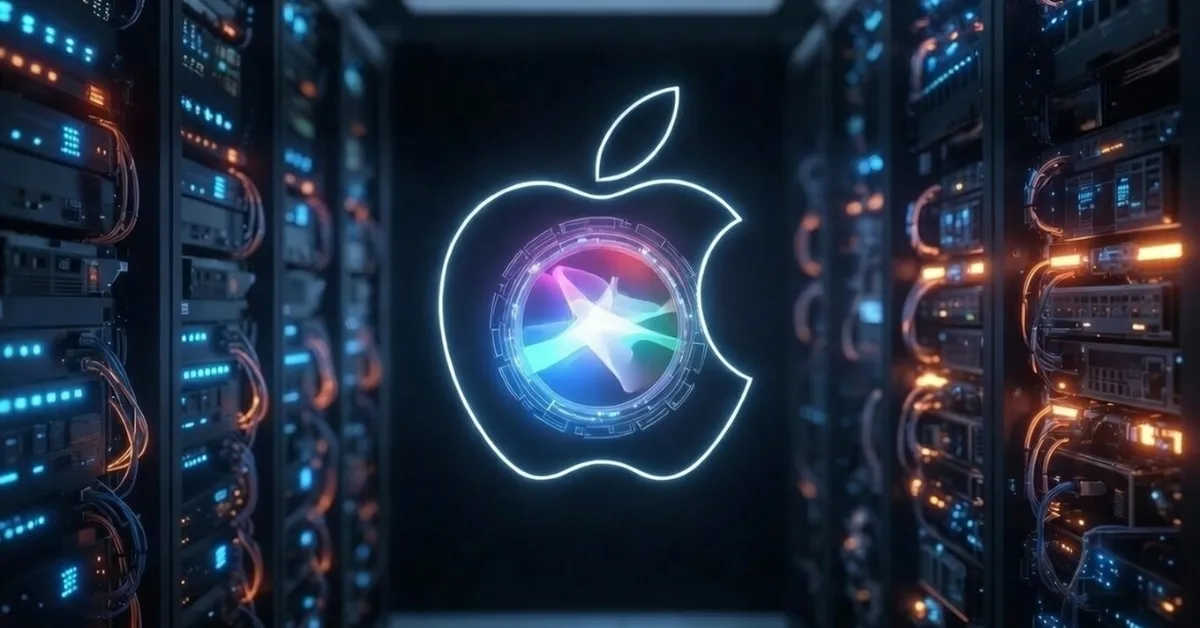
Technical documentation revealed Apple trained its foundation models on 2,048 TPUv5p chips for on-device models and 8,192 TPUv4 processors for server-based systems, all rented from Google Cloud rather than built in Apple’s famously secretive data centers. For a company that prides itself on controlling every piece of its technology stack, this represents a significant strategic concession.
The January partnership with Google formalized what technical papers already disclosed: Apple is using white-label Gemini models running on Apple’s Private Cloud Compute servers. The arrangement lets Apple access Google’s AI capabilities while maintaining the privacy architecture central to its brand.
But getting here wasn’t smooth. Apple tried merging two separate Siri systems, one for handling current commands and another based on large language models, and the hybrid approach failed. The company’s software chief Craig Federighi told employees the first-generation approach was too limited, forcing a complete architectural rethink in spring 2025.
Why Google’s Chips, Not Nvidia’s
The economics seem backwards at first. A TPU v4-Pod with 4,096 chips costs roughly $32,200 per hour on Google Cloud. For the 8,192 TPUs Apple used, that translates to about $64,400 hourly, over $1.5 million daily if running continuously.
Independent analysis suggests Nvidia’s H100 GPUs could deliver the same compute capacity for approximately $2,000 per hour, making them roughly 32 times more cost-effective. Yet Apple chose the more expensive option.
The answer lies in software and partnerships. Apple’s AXLearn machine learning framework was optimized specifically for TPUs, reflecting the influence of key executives who previously worked at Google. John Giannandrea, Apple’s AI chief until his recent demotion from Siri leadership, came directly from Google. Ruoming Pang, another senior AI leader, also transferred from Google and helped architect systems designed around TPU infrastructure.
Google confirmed that major AI companies including Anthropic, xAI, and Apple use the JAX framework for building foundation models, creating an ecosystem where TPU integration provides advantages beyond raw compute benchmarks. The software stack matters enormously.
Apple’s Google Cloud contract is also believed heavily discounted due to the companies’ broader relationship. Google pays Apple an estimated $18 to 20 billion annually to remain Safari’s default search engine. That financial arrangement likely secured pricing that closes or eliminates the cost gap.
The Leadership Chaos Behind the Scenes
The Siri overhaul triggered internal turbulence. CEO Tim Cook removed Giannandrea from Siri leadership, replacing him with Vision Pro chief Mike Rockwell, after losing confidence in his ability to deliver promised features.
Meta poached several key AI engineers from Apple, offering compensation packages as high as $200 million to lure talent during the company’s AI struggles. At an August all-hands meeting, Cook and Federighi attempted damage control, with Federighi declaring “there is no project people are taking more seriously” than Siri.
The company had publicly committed to AI features that weren’t ready, running advertisements for iPhone 16 showcasing Siri capabilities that wouldn’t ship. In March 2025, Apple announced that Apple Intelligence Siri features expected in iOS 18 wouldn’t arrive until 2026, triggering customer frustration and reportedly a federal lawsuit over alleged false advertising.
The delays stemmed from fundamental technical challenges. Grafting LLM capabilities onto Siri’s existing command-and-control architecture proved untenable. The two systems operated on different assumptions, creating friction that manifested in unreliable behavior.
Starting fresh with an LLM-first design required additional months while competitors shipped increasingly capable assistants. The pressure to deliver something that matched marketing promises likely accelerated the decision to partner with Google rather than waiting for in-house models to mature.
What Apple Actually Gets
Apple will deploy multiple Gemini models to power different aspects of Siri, using larger models for complex prompts and lighter algorithms for simpler requests to manage costs. This tiered approach mirrors industry strategies where economics force trade-offs between capability and expense.
The upgraded Siri will feature conversational abilities maintaining context across exchanges, on-screen awareness understanding what users view, and multi-step task execution spanning applications. Features include answering factual questions, being proactive about Calendar information, and potentially warning users to leave early for airport pickups based on traffic.
However, the most ambitious capabilities won’t arrive immediately. Siri’s ability to remember past conversations won’t come until iOS 27, expected to be announced at WWDC in June 2026.
All processing will occur either on-device or within Apple’s Private Cloud Compute infrastructure, with user data never reaching Google’s servers despite Google’s models powering the intelligence. This architectural isolation lets Apple maintain its privacy narrative while leveraging Google’s AI capabilities, assuming the technical implementation delivers.
The Privacy Contradiction
Apple’s privacy positioning faces its sternest test. The company spent years marketing itself as the anti-Google, the technology company that doesn’t monetize user data through advertising. Now it’s integrating Google AI into iOS.
The technical architecture theoretically preserves privacy boundaries. User queries never reach Google’s systems, according to Apple’s public statements. But perception matters as much as technical reality. Many users won’t understand the distinction between “powered by Google’s AI technology” and “sharing my data with Google.”
Privacy advocates will scrutinize implementation relentlessly. Any evidence that user data reaches Google’s servers, even anonymized telemetry, would trigger intense backlash and potentially regulatory investigation in Europe where data protection rules impose strict requirements.
What This Really Means
For Apple, success means shipping a Siri that finally matches marketing promises in spring 2026, maintaining user trust despite Google’s involvement, and eventually transitioning to proprietary models that eliminate external dependencies.
For Google, success means expanded cloud revenue, validation of TPU infrastructure, and positioning Gemini as the AI platform of choice even for companies like Apple that could theoretically build alternatives.
The spring 2026 launch will determine whether Apple’s pragmatic turn toward renting Google’s infrastructure proves strategically brilliant or a symptom of deeper competitive challenges. Either way, the decision marks a significant inflection point for a company that built its reputation on never depending on anyone else’s technology.