
Introduction: The Multimodal Revolution Accelerates
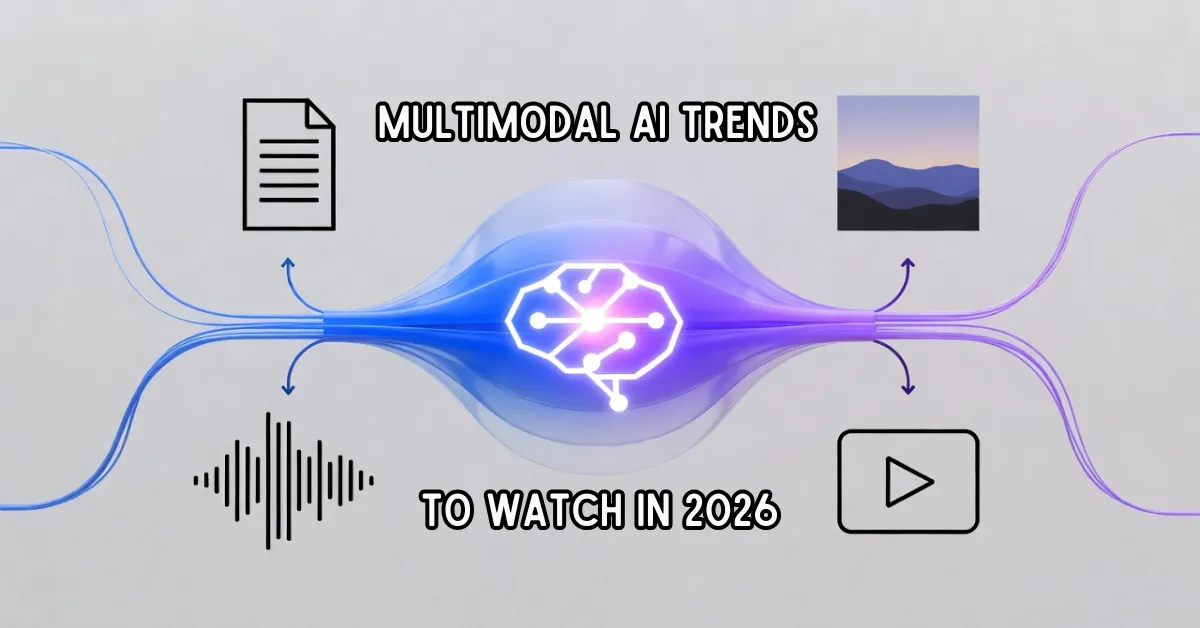
Multimodal AI represents the next frontier of artificial intelligence—systems capable of processing and generating content across multiple modalities including text, images, audio, video, and sensor data simultaneously. Unlike traditional AI models limited to single input types, multimodal systems can understand a YouTube video’s visual content, audio narration, and text captions together, or analyze medical imaging while considering patient history and verbal symptoms.
The year 2025 established the foundation for this revolution. Breakthrough models like Gemini 3, GPT-5 variants, and Claude 4 demonstrated unprecedented multimodal capabilities, moving beyond simple image captioning to sophisticated cross-modal reasoning and generation. These systems showed they could understand context across modalities, generate coordinated outputs, and handle increasingly complex real-world scenarios.
However, 2025 was largely about proof of concept and impressive demonstrations. The multimodal AI trends 2026 will witness represent something more transformative: the shift from experimental showcases to enterprise-scale deployment, immersive consumer experiences, and truly agentic applications that fundamentally change how we work, create, and solve problems.
This is the year multimodal AI moves from “look what it can do” to “look what it’s doing for millions of users every day.” Let’s explore the key trends that will define this multimodal leap.
Key Trend #1: Integration with Agentic AI and Autonomous Workflows
The future of multimodal AI 2026 is intrinsically linked to the emergence of agentic AI—systems that don’t just respond to prompts but actively plan, execute, and adapt multi-step workflows with minimal human intervention.
From Task Completion to Workflow Orchestration
Early AI assistants handled discrete tasks: “summarize this document” or “generate an image.” The agentic multimodal AI 2026 will manage complex, multi-hour workflows by:
- Reasoning across mixed inputs: An AI agent analyzing a business opportunity might review market research PDFs, watch competitor product demo videos, listen to earnings call recordings, and synthesize insights across all modalities to generate a comprehensive strategy document.
- Auto-generating adaptive workflows: Rather than following rigid scripts, these agents dynamically adjust their approach based on intermediate results. If initial video analysis reveals unexpected patterns, the agent autonomously decides to gather additional visual data or consult text databases.
- Executing extended workstreams: Industry predictions suggest multimodal AI agents will routinely handle 8+ hour workstreams by late 2026—projects like comprehensive market analysis, software testing cycles, or content production pipelines that previously required constant human oversight.
Practical Applications
Software Development: A multimodal agent watches a developer’s screen recording, reads documentation, analyzes code repositories, and listens to team discussions to automatically generate pull requests, identify bugs, and suggest architectural improvements—all while maintaining context across hours of work.
Research Synthesis: Academic researchers will deploy agents that review hundreds of papers (text), analyze experimental data visualizations (images), watch lecture recordings (video/audio), and produce comprehensive literature reviews with automatically generated charts and citations.
Creative Production: Marketing teams will use agentic multimodal systems that develop campaign concepts, generate coordinated visual assets, produce video content, write copy, and adjust creative direction based on real-time performance data across all channels.
The key differentiator in 2026 is autonomy at scale. These aren’t tools waiting for the next prompt—they’re collaborators managing substantial portions of complex projects independently.
Key Trend #2: Immersive and Real-Time Interactions
The multimodal AI models 2026 predictions consistently point toward “AI 2.0″—a paradigm shift from text-based prompt-response interactions to immersive, dynamic experiences that feel more like conversing with a capable human colleague than querying a search engine.
Beyond the Text Box
The text prompt interface served AI well during its early phases, but 2026 will see mass adoption of richer interaction modes:
Real-Time Video Understanding: AI systems will analyze live video feeds for nuanced context—not just identifying objects but understanding tone, body language, spatial relationships, and temporal dynamics. A virtual meeting assistant could note when participants look confused, suggest clarifying a point, and automatically generate visual aids based on facial expressions and verbal cues.
Voice-First Multimodal Experiences: Rather than typing “generate an image of X,” users will have flowing conversations where they describe concepts verbally, receive visual outputs, refine through natural dialogue, and seamlessly switch between discussing text documents, reviewing images, and collaborating on video projects—all through voice interaction.
Interactive Narrative Creation: Creative professionals will direct AI through immersive workflows: “Show me the design we discussed. Now rotate it 45 degrees and change the lighting to evening. Perfect. Generate a video showcasing it from multiple angles with dramatic music.”
The Sensory Web
Multimodal AI in 2026 won’t just process discrete files—it will maintain persistent, sensory understanding of digital environments:
- Contextual awareness: Systems will remember what you showed them three hours ago and reference it naturally (“That image from this morning—can you make a version for mobile?”)
- Cross-modal generation: Ask for a podcast script and the AI automatically suggests relevant images, generates matching audio, and proposes video B-roll—all coherently connected
- Emotional intelligence: Advanced models will detect emotional tone in voice, assess sentiment in visual content, and adjust communication style accordingly
This shift makes AI interaction feel less like tool operation and more like collaboration with an infinitely patient, highly capable team member who speaks every creative language fluently.
Key Trend #3: Healthcare and Scientific Breakthroughs
Among the most impactful multimodal AI in healthcare 2026 trends is the integration of AI into diagnostic and treatment workflows—not as experimental technology but as standard clinical practice.
Multimodal Diagnostics
Modern diagnosis requires synthesizing diverse information sources. Multimodal AI excels at this integration:
Comprehensive Medical Analysis: A patient presents with concerning symptoms. The AI simultaneously:
- Analyzes medical imaging (X-rays, MRIs, CT scans) for visual anomalies
- Reviews electronic health records and lab results (structured text data)
- Processes physician notes and patient-reported symptom descriptions (unstructured text)
- Considers audio recordings of breathing patterns, heart sounds, or verbal symptom descriptions
- Evaluates video of patient movement or physical examinations
Rather than forcing clinicians to mentally synthesize these disparate inputs, the AI presents integrated diagnostic hypotheses with supporting evidence from all modalities.
Predictive Power: Industry predictions suggest that by late 2026, approximately 80% of initial diagnoses in major healthcare systems will involve AI analysis—not replacing physicians but augmenting their capabilities with comprehensive multimodal pattern recognition that exceeds human capacity for processing diverse data types simultaneously.
Personalized Medicine and Drug Discovery
Treatment Optimization: Multimodal AI analyzes patient genetics, medical imaging, lifestyle data from wearables, dietary information, and treatment response patterns to recommend highly personalized therapeutic approaches. The system considers how similar patients (identified through multimodal similarity matching) responded to various interventions.
Accelerated Research: Drug discovery increasingly relies on multimodal AI analyzing molecular structures (3D visual data), genetic sequences (specialized text/data), research literature (text), experimental results (numerical data and visualizations), and even protein folding simulations (video/animation) to identify promising therapeutic candidates orders of magnitude faster than traditional methods.
Mental Health Applications
Mental health stands to benefit enormously from multimodal approaches:
- Analyzing speech patterns (audio) alongside self-reported symptoms (text) and facial expressions (video) for depression screening
- Providing immersive therapeutic experiences combining visual, audio, and interactive elements
- Monitoring treatment effectiveness through multimodal behavioral signals
The future of multimodal AI 2026 in healthcare isn’t about automation—it’s about augmentation, giving healthcare providers superhuman pattern recognition while preserving the essential human elements of care, empathy, and judgment.
Key Trend #4: Physical AI and Robotics Embodiment
Perhaps the most exciting frontier is “physical AI”—multimodal intelligence systems embedded in robots, autonomous vehicles, and edge devices that interact with the physical world.
The Multimodal Robotics Stack
Effective physical AI requires processing diverse sensory inputs simultaneously:
Environmental Understanding: A warehouse robot doesn’t just “see” objects through cameras—it integrates:
- Visual data (multiple camera angles, depth perception)
- Audio cues (detecting equipment sounds, human speech, environmental hazards)
- Tactile feedback (pressure sensors, temperature, texture)
- Positional data (accelerometers, gyroscopes, GPS)
- Text instructions (from management systems or human operators)
Adaptive Execution: Unlike programmed robots following rigid instructions, multimodal AI-powered systems adapt to unexpected situations. A delivery robot encountering construction might process visual road signs, audio announcements, human verbal directions, and text navigation data to determine an alternative route—then explain its decision if questioned.
Real-World Applications Taking Off in 2026
Manufacturing and Logistics: Smart factories employ robots that watch human demonstrators (video), follow verbal instructions (audio), read technical manuals (text), and use visual inspection to quality-check products—all while coordinating with other robots through multimodal communication protocols.
Healthcare Robotics: Surgical assistance robots integrate pre-operative imaging (visual data), real-time video from multiple angles, audio communication with surgical teams, and patient vital signs (numerical sensor data) to provide intelligent support during procedures.
Agriculture: Autonomous farming equipment analyzes crop health through multispectral imaging (visual), soil moisture sensors (numerical data), weather forecasts (text/data), and even plant audio signatures (recent research shows plants emit ultrasonic sounds under stress) to optimize irrigation, fertilization, and harvesting.
Autonomous Vehicles: Self-driving technology in 2026 combines cameras (visual), LIDAR (spatial data), audio (sirens, horns, unusual engine sounds), GPS (positional), weather data (text/numerical), and increasingly, vehicle-to-vehicle communication—all processed through multimodal AI that makes split-second decisions in complex traffic scenarios.
The Edge Computing Enabler
Physical AI requires real-time processing, often in environments without reliable cloud connectivity. The multimodal AI trends 2026 include massive improvements in edge computing capabilities—specialized chips that can run sophisticated multimodal models locally on devices, enabling responsive physical AI even in remote locations.
Key Trend #5: Enterprise-Scale Multimodal Search and Knowledge Management
Organizations drown in unstructured data across formats. Multimodal AI transforms this challenge into opportunity.
Unified Knowledge Discovery
Traditional enterprise search operates in silos—document search, image libraries, video archives exist separately. Multimodal search in 2026 enables queries like: “Find all materials related to the Johnson project discussed in Q3” and retrieves:
- Meeting recordings and transcripts
- Presentation slides and whiteboards
- Email threads and chat logs
- CAD files and design mockups
- Spreadsheets and reports
The AI understands semantic relationships across modalities, connecting a verbal discussion in a video meeting with relevant diagrams in a PowerPoint and related financial data in Excel.
Automated Documentation and Institutional Memory
Meeting Intelligence: Multimodal systems don’t just transcribe meetings—they watch presentations, capture whiteboard diagrams, note participant reactions, identify action items from verbal commitments, and generate comprehensive documentation linking all elements.
Training and Onboarding: New employees access AI tutors that combine text documentation, video tutorials, audio explanations, and interactive simulations—all coordinated through multimodal understanding of the learning objective and the individual’s progress.
Compliance and Auditing: Regulated industries use multimodal AI to monitor operations across text logs, surveillance video, audio recordings, and sensor data to ensure compliance, automatically flagging potential issues while maintaining context across all information sources.
Future Outlook: What Comes After 2026?
The multimodal AI models 2026 predictions represent just the beginning of a longer transformation.
Near-Term Evolution
Improved Efficiency: Current multimodal models require significant computational resources. Expect rapid efficiency gains making these capabilities accessible on smartphones and IoT devices.
Enhanced Reasoning: While 2026 models excel at pattern recognition across modalities, the next frontier is deeper causal reasoning—truly understanding “why” across diverse information types.
Seamless Integration: Today’s multimodal AI often requires explicit switching between modalities. Future systems will fluidly move between visual, verbal, and textual communication based on context without prompting.
Challenges to Address
Bias and Fairness: Multimodal systems can amplify biases present in training data across multiple dimensions—visual stereotypes, linguistic biases, audio-based discrimination. Addressing this requires careful auditing and mitigation strategies.
Privacy and Consent: Multimodal AI’s ability to process video, audio, and visual data raises serious privacy concerns. Robust governance frameworks must evolve alongside the technology.
Validation and Trust: In critical applications like healthcare, establishing trust in multimodal AI recommendations requires transparent reasoning and rigorous validation across all input modalities.
Resource Intensity: Despite efficiency improvements, multimodal AI remains computationally demanding, raising questions about environmental impact and accessibility for smaller organizations.
The Democratization Question
Will multimodal AI capabilities remain concentrated among tech giants, or will open-source initiatives and API access democratize these tools? The answer significantly impacts innovation, competition, and societal benefit.
Early signs suggest a hybrid model: frontier capabilities initially exclusive to major AI labs, with powerful but slightly less advanced multimodal systems becoming widely accessible through APIs, open-source releases, and specialized providers.
Conclusion: Embracing the Multimodal Future
The multimodal AI trends 2026 point toward a fundamental reshaping of human-computer interaction. We’re moving from systems that process information in narrow channels to AI that perceives and generates across the full spectrum of human communication and sensory experience.
Key takeaways:
- Agentic multimodal AI 2026 will autonomously manage complex, multi-hour workflows across diverse data types
- Real-time, immersive interactions will replace static text prompts as the primary AI interface
- Healthcare and scientific research will see transformative improvements through integrated multimodal analysis
- Physical AI brings multimodal intelligence into robotics and the physical world
- Enterprise knowledge management will unify organizational intelligence across all content formats
For organizations and individuals, the imperative is clear: start experimenting now. The gap between those who adapt to multimodal AI workflows and those who don’t will widen rapidly in 2026 and beyond.
The future doesn’t belong to those who can prompt AI best in text—it belongs to those who can collaborate with AI across every modality, leveraging these systems as creative and analytical partners rather than mere tools.
The multimodal leap isn’t just about smarter AI—it’s about AI that finally speaks every language humans use to understand, create, and interact with the world. And that changes everything.
Frequently Asked Questions
What exactly makes AI “multimodal”?
Multimodal AI can process, understand, and generate content across multiple types of data—text, images, audio, video, and sensor data—simultaneously. Unlike traditional AI models limited to one input type, multimodal systems can analyze a video’s visuals, audio, and captions together, understanding how these elements relate to each other.
How is 2026 different from 2025 for multimodal AI?
2025 focused on demonstrating multimodal capabilities and releasing foundational models. 2026 represents the deployment phase—moving from research labs to enterprise applications, consumer products, and real-world implementations at scale. It’s the shift from “proof of concept” to “daily reality.”
Will multimodal AI replace jobs?
Like previous technological shifts, multimodal AI will transform rather than simply eliminate jobs. Some routine roles will be automated, but new roles will emerge in AI supervision, multimodal content creation, and human-AI collaboration. The key is adapting skills to work alongside these systems effectively.
What industries will see the biggest multimodal AI impact in 2026?
Healthcare (diagnostics and personalized medicine), manufacturing and robotics, creative industries (content production), software development, scientific research, and customer service will see substantial transformation. Any field requiring synthesis of diverse information types will benefit.
Is multimodal AI accessible to small businesses?
Increasingly, yes. While cutting-edge models require significant resources, API access to powerful multimodal systems is becoming more affordable. Cloud platforms offer pay-as-you-go multimodal AI services that small businesses can integrate into their workflows without massive infrastructure investments.
What are the main risks of multimodal AI?
Key concerns include privacy violations (especially with video/audio processing), amplified bias across multiple modalities, deepfakes and synthetic media misuse, over-reliance on AI for critical decisions, and the environmental cost of computationally intensive models. Responsible deployment requires addressing these proactively.
How can I prepare for the multimodal AI future?
Start experimenting with available multimodal tools, diversify your content creation skills across formats, develop critical thinking about AI outputs, stay informed on developments, and most importantly, focus on uniquely human skills—creativity, empathy, strategic thinking—that complement rather than compete with AI.
Will open-source multimodal AI catch up to proprietary models?
The gap is narrowing. Open-source efforts like LLaVA and others show impressive capabilities, though they typically lag frontier models by 6-18 months. For many practical applications, open-source multimodal AI in 2026 will be more than sufficient, especially as efficiency improvements make smaller models more capable.